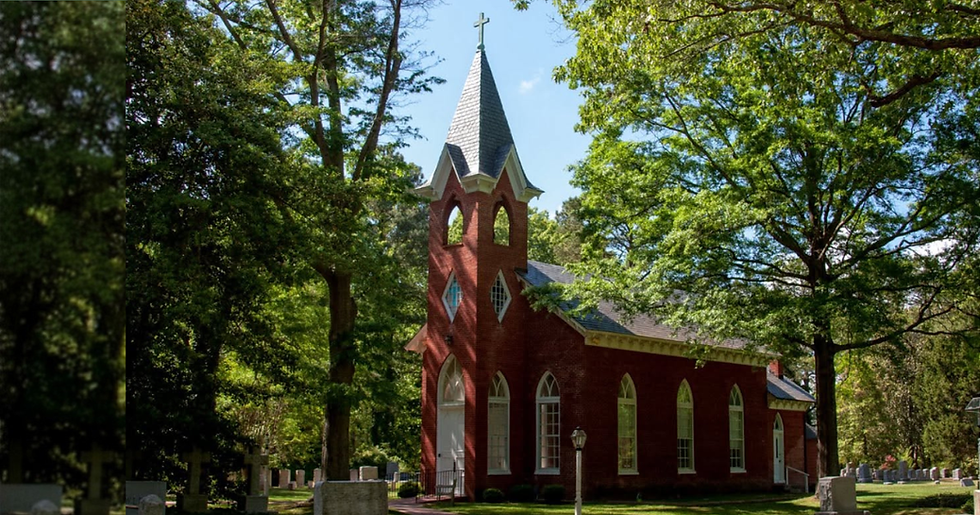
Trinity Episcopal Church, Arlington – Navigating Urban Change and Planning for the Future

Updated: Aug 18, 2025
As its neighborhood transformed from suburban to urban, Trinity Episcopal Church in Arlington faced new challenges in parking, attendance, and financial stability. With support from a Virginia Housing pre-planning grant through VEREP, the church is exploring redevelopment options that align with its mission, address community needs, and ensure long-term sustainability.
Case study provided by Kat Turner, Virginia Episcopal Real Estate Partners (VEREP)
Trinity Episcopal Church, Arlington - What happens when your neighborhood gets urbanized?

Historical Context and Neighborhood Changes
Trinity Episcopal Church has been at its current location on Columbia Pike since 1903.
It was a suburban neighborhood, and Trinity’s congregation walked to church, eventually utilizing on-street parking and benefiting from the generosity of nearby businesses that allowed parishioners to use their parking lots on Sundays.
In recent years, Columbia Pike has become more commercialized and highly developed. Street parking became restricted to residents with permits, and the new developments on the Pike tended to have restricted underground or commercial parking not available to church attendees.
Impact of COVID-19 and Current Operations
The COVID pandemic severely disrupted operations at the church, especially its child care center, which operates below capacity, but the congregation size and attendance have stabilized since the pandemic. However, the church used to serve as a gathering place for community activities, and the loss of easily accessible parking has impacted its use for these purposes. This loss also impacts the neighborhood's identification with the church.
Financial Picture and Income Sources
The church experiences an annual budget deficit, but the sale of a house on its site has provided resources to give it some time to consider a more financially stable future. The current income streams for the church are:
Declining pledge and plate income
Rental income from the child care center and another congregation that uses the facilities
Proceeds from an off-site thrift shop
User group donations
Vision Committee and Mission Goals
In 2009, Trinity commissioned a Vision Committee to make recommendations on how the church could live into its mission. Those recommendations included:
Serving youth
Maximizing current building use
Land and property development
Stewardship and member recruitment
Zoning and Redevelopment Potential
Arlington County has adopted a form-based code that regulates the maximum development that can occur on a site with specificity. The church’s 1.2-acre parcel features the 1957 church building, with later additions including a parish hall and a child care center. There are also two single-family homes (one of which is used as a rectory) and a playground. Trinity’s property lies at the intersection of three different zoning districts and would permit denser development, such as multi-family housing, particularly for seniors.
Discernment and Preplanning Support
Developers have approached Trinity, but it has realized that it needs to review its options for the future and make a decision about what it wants before allowing a developer to set the agenda. The Vision Committee continues to work with a discernment coach and the congregation to chart a future for Trinity.
A preplanning grant to Virginia Episcopal Real Estate Partners from Virginia Housing is allowing Trinity to explore its options, including redeveloping the whole site to its maximum allowable density and including dedicated church space within a new building.
Status
The congregation continues its discernment about its future, and the preplanning grant will provide hard data on the costs and potential benefits of the options under consideration. The study is expected to be completed in Fall 2025.
Is your church considering redevelopment options? VEREP can help you explore options that align with your mission and community needs.